


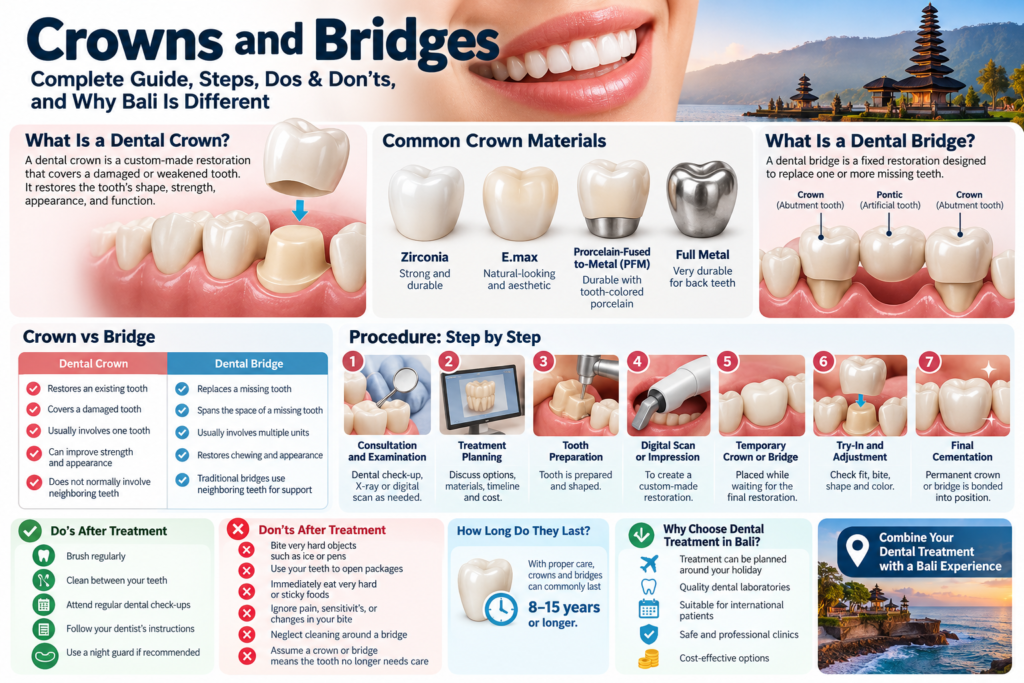
Crowns and Bridges: Complete Guide, Steps, Dos & Don’ts, and Why Bali Is Different
A healthy smile is not only about appearance—it also plays an important role in chewing, speaking, and overall oral function. When a tooth is badly damaged or a tooth is missing, dental crowns and bridges can be effective restorative solutions.
For international visitors, Bali has also become a popular destination for dental treatment. Many dental clinics in Bali offer restorative treatments such as crowns and bridges, with treatment plans designed around patients who may only be staying on the island for a limited time.
But before choosing treatment, it is important to understand what crowns and bridges are, how the procedure works, how to care for them, and what makes dental treatment in Bali different.
What Is a Dental Crown?
A dental crown is a custom-made restoration that covers a damaged or weakened tooth. It acts like a protective cap, restoring the tooth’s shape, strength, appearance, and function.
A dentist may recommend a crown when a tooth has:
- Extensive tooth decay
- A large filling with insufficient remaining tooth structure
- A cracked or fractured tooth
- Significant wear
- Undergone root canal treatment
- Aesthetic concerns involving the shape or color of the tooth
Unlike a filling, which restores part of the tooth, a crown covers the remaining visible tooth structure.
Common Crown Materials
Depending on the location of the tooth, bite, aesthetic expectations, and clinical condition, your dentist may discuss several materials, including:
Zirconia
Known for strength and durability, making it suitable for both front and back teeth.
E.max / Lithium Disilicate
Popular for highly aesthetic restorations because of its natural-looking translucency.
Porcelain-Fused-to-Metal (PFM)
Combines a metal substructure with a tooth-colored porcelain exterior.
Full Metal
Very durable and commonly considered for certain posterior teeth where aesthetics are less important.
There is no single “best” crown material for every patient. Your dentist should recommend the material based on your tooth, bite, position, aesthetic requirements, and overall oral condition.
What Is a Dental Bridge?
A dental bridge is a fixed restoration designed to replace one or more missing teeth.
A traditional bridge generally consists of:
- Abutment teeth – the supporting teeth
- Crowns – placed over the supporting teeth
- Pontic – the artificial tooth that fills the missing space
For example, a traditional 3-unit bridge can replace one missing tooth using the two neighboring teeth as support.
Other bridge designs include:
- Traditional bridges
- Implant-supported bridges
- Maryland bridges
- Cantilever bridges
The appropriate option depends on the location of the missing tooth, the condition of the neighboring teeth, your bite, and your overall treatment plan.
Crown vs Bridge: What’s the Difference?
| Dental Crown | Dental Bridge |
|---|---|
| Restores an existing tooth | Replaces a missing tooth |
| Covers a damaged tooth | Spans the space of a missing tooth |
| Usually involves one tooth | Usually involves multiple units |
| Can improve strength and appearance | Restores chewing and appearance |
| Does not normally involve neighboring teeth | Traditional bridges use neighboring teeth for support |
If the tooth is still present but significantly damaged, a crown may be considered.
If a tooth is missing, a bridge may be one possible treatment option. Your dentist should evaluate whether a bridge, implant, or another restoration is more appropriate.
The Dental Crown & Bridge Procedure: Step by Step
1. Consultation and Dental Examination
The process begins with a clinical examination.
Your dentist may assess:
- Tooth structure
- Gums and surrounding tissues
- Bite and occlusion
- Existing restorations
- Signs of infection
- The condition of neighboring teeth
X-rays or digital scans may also be required depending on the case.
This first appointment is important because a crown or bridge should not simply be placed without determining whether the supporting tooth or surrounding tissues are suitable.
2. Treatment Planning
After the examination, your dentist will discuss your treatment options.
This may include:
- Crown or bridge type
- Material options
- Number of units
- Expected treatment time
- Laboratory process
- Estimated cost
- Temporary restoration
- Follow-up appointments
If additional treatment such as root canal therapy, tooth build-up, or gum treatment is necessary, this may need to be completed before the final restoration.
3. Tooth Preparation
For a conventional crown, the dentist carefully prepares the tooth to create enough space for the restoration.
For a traditional bridge, the supporting teeth may also need to be prepared.
Local anaesthetic can be used to make the procedure more comfortable.
4. Digital Scan or Dental Impression
Once the teeth are prepared, the dentist takes an impression or digital scan.
The information is then used by the dental laboratory to create a restoration that fits the prepared teeth and matches the planned shape and shade.
5. Temporary Crown or Bridge
Depending on the treatment, a temporary restoration may be placed while the permanent crown or bridge is being fabricated.
The temporary restoration helps protect the prepared tooth and allows you to maintain function while waiting for the final restoration.
6. Try-In and Adjustment
When the permanent crown or bridge is ready, the dentist checks:
- Fit
- Bite
- Shape
- Color
- Contact with neighboring teeth
- Comfort
- Overall appearance
Small adjustments may be necessary before final cementation.
7. Final Cementation
Once everything has been checked and approved, the permanent restoration is bonded or cemented into position.
The dentist will perform a final bite and comfort check before completing the treatment.
What Should You Do After Getting a Crown or Bridge?
DO:


Maintain good oral hygiene around the restoration.
For bridges, special floss threaders or interdental brushes can help clean underneath the pontic.
Your dentist can monitor the restoration and the supporting teeth.
Your individual case may require specific aftercare.
Patients who grind or clench their teeth may benefit from additional protection.
What Should You Avoid?
DON’T:

A crown can protect a tooth, but the underlying tooth and surrounding gums still require proper oral hygiene.
How Long Do Crowns and Bridges Last?
There is no guaranteed lifespan for a dental crown or bridge.
Longevity depends on factors such as:
- Oral hygiene
- Bite forces
- Tooth grinding
- Quality of the restoration
- Condition of the supporting teeth
- Gum health
- Regular dental maintenance
Some dental clinics report crowns and bridges commonly lasting around 8–15 years or longer with proper care.
However, individual results can vary significantly.
Why Is Dental Treatment in Bali Different?
Bali has become a popular destination for international dental patients, particularly visitors from countries where private dental treatment can be considerably more expensive. Current Bali dental sources show that clinics offer crowns, bridges, implants, cosmetic dentistry, and other restorative treatments to both tourists and residents.
But the biggest difference is not simply the location or price.
1. Treatment Can Be Planned Around Your Holiday
Many Bali dental clinics regularly treat international patients.
Some clinics offer treatment schedules designed around patients who have limited time on the island. Depending on the case and laboratory turnaround, crowns and bridges may require multiple visits over several days.
However, not every case can or should be rushed.
Complex treatment may require additional appointments, laboratory time, or preliminary procedures.
2. Dental Laboratories Play an Important Role
Crowns and bridges are custom-made restorations.
The quality of the final result depends not only on the dentist but also on communication between the dentist and dental laboratory.
Factors such as:
- Accurate impressions or scans
- Shade selection
- Material selection
- Bite records
- Laboratory quality control
- Final adjustments
can all affect the result.
Some Bali clinics use external laboratories, while others have closer or in-house laboratory workflows.
3. International Patients Need to Plan Carefully
If you are visiting Bali specifically for dental treatment, don’t book your flight home immediately after your first appointment.
Allow enough time for:
Consultation → Preparation → Laboratory fabrication → Try-in → Adjustment → Final placement
This is especially important for bridges, multiple crowns, or cases requiring additional dental procedures.
Is Bali Dental Treatment Safe?
The important question should not simply be:
“Is dental treatment in Bali safe?”
Instead, ask:
“Is this particular clinic and treatment plan appropriate for my dental condition?”
Before treatment, consider checking:
- Dentist credentials and registration
- Clinic licensing
- Sterilization and infection-control procedures
- Dental laboratory used
- Materials being offered
- Written treatment plan
- What is included in the quoted price
- Follow-up arrangements after you return home
For international patients, it is also useful to ask what happens if the restoration needs an adjustment after you leave Bali.
How Much Do Crowns and Bridges Cost in Bali?
Prices vary significantly depending on:
- Crown or bridge material
- Number of units
- Complexity of the case
- Laboratory
- Additional procedures
- Dentist and clinic
For example, published Bali clinic information currently shows crown prices ranging from several million rupiah per tooth, while bridge pricing depends on the number of units and material selected.
Always request a personalized quotation after examination. Online prices should be treated as indicative rather than a guarantee of the final treatment cost.
Frequently Asked Questions
Can I get a crown in one day?
Some clinics may offer accelerated or same-day workflows for selected cases, but this is not suitable for everyone. Laboratory requirements and the complexity of the tooth can affect the timeline.
Do I need a root canal before a crown?
Not necessarily. A root canal is generally considered when the tooth’s pulp is irreversibly damaged or infected. Your dentist needs to assess the tooth before deciding.
Can a bridge replace an implant?
A bridge and an implant are different treatment options. A bridge uses supporting teeth or implants, while an implant replaces the missing tooth root. Your dentist can discuss which option is appropriate for your case.
Can I eat normally after getting a crown?
Usually, normal eating can resume according to your dentist’s instructions. However, immediately after treatment, you may be advised to avoid certain foods until the restoration is fully settled or the local anaesthetic has worn off.
How long should I stay in Bali for a crown or bridge?
There is no single answer. Some clinics recommend several days, while more complex cases can take longer. Published Bali clinic guidance ranges from several days to around 7–10 working days depending on the restoration and laboratory process.
Final Thoughts
Dental crowns and bridges can restore much more than the appearance of your smile. They can help restore function, comfort, tooth structure, and confidence.
If you’re considering dental treatment in Bali, don’t choose a treatment based on price alone. Start with a proper examination, understand your options, ask about the material and laboratory process, and make sure you have enough time for the treatment and any necessary adjustments.
Your smile deserves a treatment plan—not just a quick fix.
This article is for general educational purposes and does not replace an examination or diagnosis by a qualified dentist.